

Nvidia Enters the PC Chip Business with the RTX Spark. Here Is What to Make of It.
Nvidia has entered the PC chip market. Here is the strategic logic behind the move, what could go right, and the risks the launch coverage glossed over.


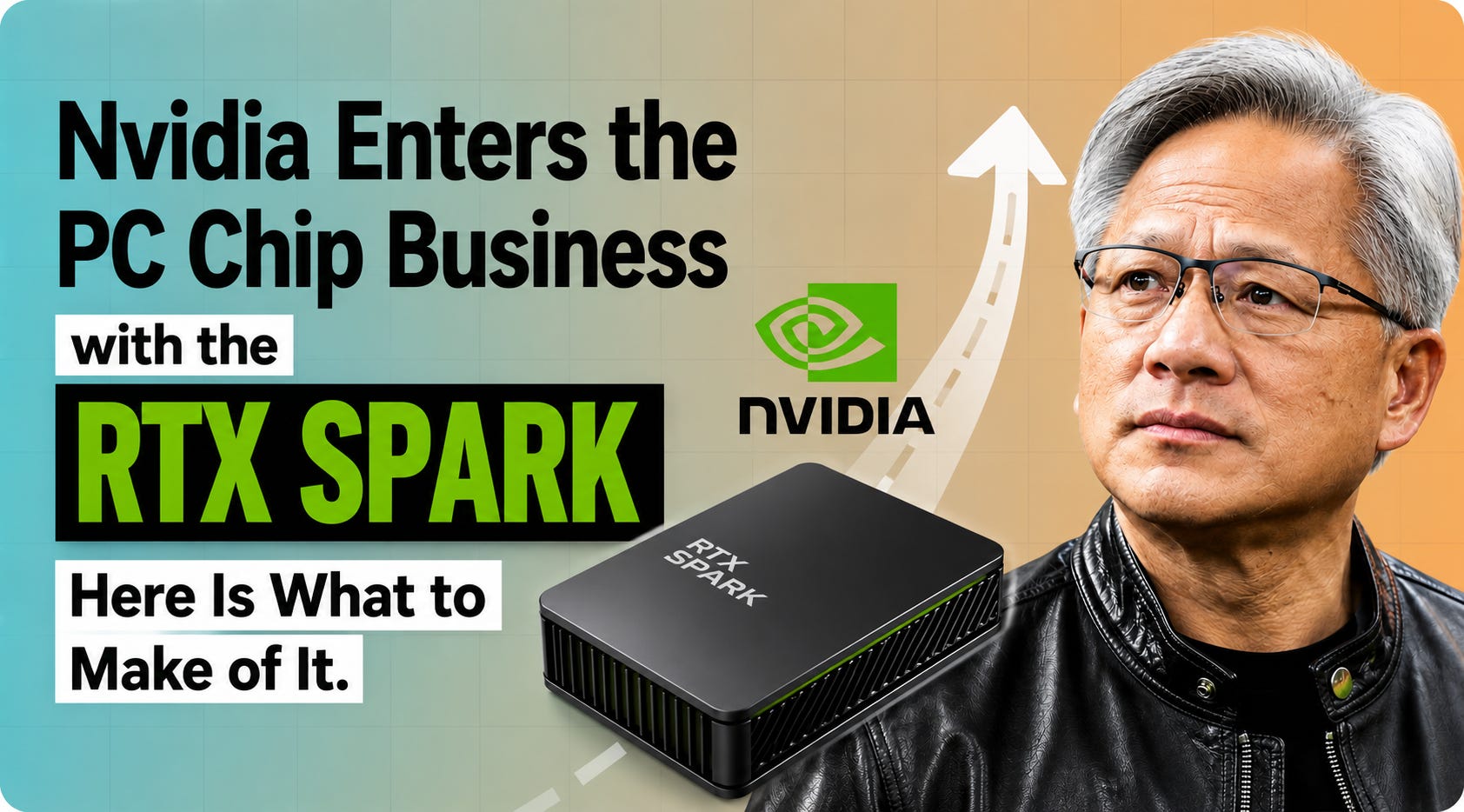
At the Computex 2026, Nvidia announced the RTX Spark — an ARM-based chip combining its own CPU and GPU on a single piece of silicon, aimed at Windows laptops and compact desktops. It is the company’s first serious entry into the consumer PC processor market, arriving in devices this fall.
The announcement got a lot of coverage, most of it breathless. This piece tries to do something more useful: work through why Nvidia actually made this move, what it could mean for the business, and where the real risks sit.
What Nvidia Is Actually Doing Here
The most precise way to describe RTX Spark is this: Nvidia is becoming a full-system chip vendor for Windows PCs, the same way Apple became one for Macs with its M-series in 2020.
Previously, when you bought a Windows laptop with an Nvidia GPU, Nvidia sold one component into that system i.e. the graphics card. Intel or AMD made the CPU. The PC maker assembled the whole thing. Nvidia captured a slice of the device’s value.
With RTX Spark, co-developed with MediaTek and built on TSMC’s 3nm process, Nvidia is the sole chip supplier for the entire compute layer — CPU, GPU, and AI processing all in one package. That changes the economics of every device it goes into.
A brief note on what RTX Spark actually is, technically.
When most people hear “CPU,” they picture an Intel Core i5 or i7 — a general-purpose chip that runs the operating system, your browser, your spreadsheets, and everything else. RTX Spark does include a CPU component, but it is better described as a System-on-a-Chip (SoC) — a single piece of silicon that combines a CPU, a GPU, and a dedicated AI processor, all sharing the same memory pool.
Think of it the way Apple’s M4 chip works: there is no separate graphics card, no separate AI accelerator — everything is fused together. The CPU inside RTX Spark is an ARM-based design (Nvidia’s Grace architecture, 20 cores), which uses a different instruction set from Intel and AMD’s x86 architecture.
Windows has already run on ARM before, most notably through Qualcomm-powered Windows laptops, but the experience has been mixed because a lot of Windows software was originally written for x86 and has to be translated or recompiled. That matters for this initiative because RTX Spark is a bet that Windows on ARM can become good enough, broad enough, and developer-friendly enough to matter at scale.
The meaningful difference from a traditional Intel laptop is that the GPU and AI silicon are not afterthoughts bolted on separately. They are first-class citizens sharing the same pool of fast memory, which is why the AI performance numbers are so much higher than what conventional laptops can achieve.
The Reasons Behind the Move
The data center customer base is narrow. And getting narrower.
Nvidia’s revenue is heavily concentrated in hyperscalers: Google, Microsoft, Amazon, Meta. These are extraordinary customers, but they are a handful of buyers, and all of them are actively developing their own custom AI chips to reduce how much they spend on Nvidia hardware. This is not speculation — Google has TPUs, Amazon has Trainium, Microsoft has Maia. The hyperscalers are not trying to eliminate Nvidia, but they are trying to cap their dependency on it.
Opening a second front in consumer PCs, where the customer base is hundreds of millions of devices and thousands of OEM configurations, is a structurally sensible response to that concentration risk. Jensen Huang has described the CPU market as a $200 billion opportunity. Even capturing a modest share of that changes Nvidia’s revenue profile meaningfully.
The AI workload is slowly moving off the cloud.
For the past few years, AI meant sending a query to a server and getting a response back. That model works, but it has real drawbacks: latency, privacy concerns, ongoing usage costs, and dependency on internet connectivity. The industry has been pushing toward “local AI” — models that run on your own device — and the technical bar for that is only now becoming achievable in thin-and-light hardware.
RTX Spark delivers 1 petaflop of AI compute, which Nvidia claims is roughly 20x more than what Qualcomm’s Snapdragon X offers. If on-device AI agents become a real product category — software that manages tasks, edits documents, runs workflows locally — then the chip enabling those agents becomes the critical component in every PC sold. Nvidia is making a bet that this inflection is real and that it will happen over the next three to five years.
CUDA is their moat, and they need it to travel with them.
CUDA is the software ecosystem Nvidia spent two decades building. It is the reason AI researchers and developers default to Nvidia hardware — not because Nvidia GPUs are magically better at every task, but because the tooling, the libraries, and the institutional knowledge are all built around CUDA. It is a genuine competitive moat.
To be precise about how this moat works: CUDA is a programming platform that lets developers write code which runs directly on Nvidia GPUs, regardless of whether those GPUs are sitting in a data center or in a laptop. It sits one level above the chip architecture — so the relevant question is not ARM vs. x86, but rather: which GPU is in the device? If developers are writing and testing AI applications on Apple laptops (which use Apple’s own GPU and Metal framework) or on Qualcomm-powered Windows machines (which use Qualcomm’s AI SDK), they are building workflows and optimizations around those GPU ecosystems, not CUDA. Over time, if the machines that developers actually carry around and prototype on are not running Nvidia GPUs, the daily gravitational pull of CUDA weakens — not because ARM replaced x86, but because a different GPU and its associated software stack became the default development environment. The risk, in short, is displacement at the point of developer habit formation. RTX Spark puts an Nvidia GPU — and therefore CUDA — back into the laptop that a developer uses every day. That is the connection Nvidia is trying to preserve.
Nvidia noted that porting the full software stack to this new architecture took the equivalent of 33 years of engineering effort — which tells you something about how seriously they treated this transition, and how hard it would be for someone else to replicate quickly.
What Could Go Well
The OEM response has been strong. ASUS, Dell, HP, Lenovo, MSI, and Microsoft are all confirmed to build devices around RTX Spark. This is not a situation where Nvidia is launching a chip and hoping someone builds around it. The partner lineup at launch is comparable to what a mature platform would have.
Microsoft is doing more than just licensing Windows to these devices. It is building new AI agent frameworks and security primitives specifically optimized for RTX Spark. That kind of OS-level co-development is meaningful — it means Microsoft has a stake in this platform succeeding, not just as a hardware partner but as a software one.
And Nvidia did not announce one chip. They announced a multi-generation roadmap: the current Grace Blackwell generation, followed by Vera Rubin, followed by Rosa Feynman. OEMs need this kind of commitment before they retool their supply chains. By making the roadmap public, Nvidia is signaling continuity — which is something Qualcomm also tried to signal in this market, but with less credibility given its mixed execution record.
The market reaction was also telling. On announcement day, Intel fell ~4.5%, AMD dropped ~5.5%, and Qualcomm slid nearly 9%. PC makers Dell and HP each rose over 7%. The market read this as Nvidia credibly threatening the existing chip order in PCs, not as a long-shot diversification bet.
Where the Real Risks Are
Windows on ARM is a structurally hard problem.
This is probably the most important risk, and it deserves more attention than it got in the launch coverage. Windows was built for x86 chips made by Intel and AMD. The software library for Windows — games, enterprise tools, professional plugins, anti-cheat systems — was overwhelmingly written for that architecture. Running it on ARM requires either recompilation by the developer, or emulation by the hardware, both of which create friction.
Qualcomm has been trying to solve this problem with its Snapdragon chips for several years, with partial success. Nvidia has a stronger software stack than Qualcomm did at launch, and Microsoft has been improving Windows on ARM compatibility. But the long tail of software that does not work correctly on ARM is genuinely long, and Nvidia cannot fix it unilaterally. This is a multi-year ecosystem problem, and consumers will encounter it.
The demand for AI PCs has not been proven at scale.
“AI PC” has been a major industry theme since 2024. The commercial results have been underwhelming. Dell has noted that AI PC demand came in below their earlier expectations. The honest answer is that we do not yet know whether consumers, as opposed to AI developers and enterprise power users, will pay a meaningful premium for on-device AI compute. If the answer turns out to be no, or not yet, then RTX Spark’s pricing power and market penetration both disappoint.
Entering a margin-thin business.
Nvidia’s current economics are exceptional. Its data center segment operates at margins that most hardware companies would consider implausible. The PC chip business is structurally different. It is competitive, OEMs push hard on pricing, and commoditization is the natural direction over time. Nvidia entering this market at scale may be strategically necessary, but the earnings profile of the business it is entering looks nothing like the business it currently runs. This is worth keeping in mind when modeling what success actually looks like for RTX Spark from an investor perspective.
Geopolitical concentration does not go away.
RTX Spark is manufactured at TSMC on its 3nm node. This is the same foundry and process node that Nvidia’s data center chips depend on. Diversifying into consumer PCs does not reduce Nvidia’s exposure to Taiwan as a geopolitical risk factor — it deepens it, because now both business lines run through the same chokepoint. This is not a new risk for Nvidia shareholders, but it is worth noting that this expansion does nothing to address it.
How to Think About This
The RTX Spark is a logical and well-executed move that is solving a real strategic problem, which is Nvidia’s customer concentration and its need to extend its software moat. But it is entering a market where the demand thesis is unproven and the competitive challenges are structural, not just technical.
The Apple M-series comparison is everywhere in the coverage, and it is not wrong, but it has an important asterisk: Apple controlled the entire product: hardware, OS, software distribution, and retail. Nvidia is selling a chip to Dell and HP, who are assembling devices running Microsoft’s operating system. The coordination advantages that made Apple’s transition so clean simply do not exist here in the same form.
That does not make this a bad bet. It just makes it a harder one. The fall 2026 launch will tell us a lot about whether OEMs are pricing these devices competitively, whether consumers are actually buying them, and whether the software compatibility issues are manageable in practice. Those data points are what will determine whether RTX Spark is a genuine strategic expansion or an expensive experiment.